
What is Fertility? – Boilogicals
By Halderman
What is Fertility? – Biologicals
(Ninth in a series)
Soil Health was discussed in a recent blog. It is most commonly assessed by some metric of biological activity, and since beneficial biological activity is absolutely integral to crop growth and yield, it shouldn’t be surprising that one of the relatively new categories of fertility products are “Biologicals”. Microbiological activity is a key part of the nutrient cycling process in the soiland the nutrient acquisition process by plants for many soil-supplied nutrients. With this in mind, let’s look at some of the different types of biological products in the marketplace.
One broad category would be products that are species of living bacteria or fungi which are thought to be beneficial to crop growth. In most cases this sector of the industry is trying to identify, and/or develop, unique species of microbiological organisms as their product. It could be seen as similar to the seed industry in some ways. They use ‘breeding’ and selection techniques to create and isolate new species and test them for efficacy in improving yields.
The biggest challenges with this approach are the various logistical realities of product distribution and field application. For example, the shelf life of the product…can the living product stay alive through production, shipment, and possibly lengthy storage at the retail outlet and/or the farm? Can it survive all the possible different temperature environments it may experience in its storage and transport? If it’s applied through a sprayer, can it survive exposure to other fertility or herbicide products and be applied simultaneously without damage to living microbiology? If not, how much cleaning is necessary if the sprayer was used for other products or needs to switch back and forth? Probably the biggest issue is what usually happens to the vast majority of life forms that are introduced into a foreign ecosystem to which they are not adapted…. They become a food source for the species that are native (and well-adapted) to that particular environment.
The other broad category, which is non-living products, would include many variations, both in type and purpose. These are meant to promote natural plant processes or the soil processes that make nutrients plant available. Among these could be some form of enzymes, plant extracts, fermentation products, or carbon-based acids. These are designed to influence the beneficial activities of existing soil microorganisms. Various types of sugars are sometimes included in products or used by themselves to directly spike microbiological activities by providing an additional food source.
Before considering additional inputs and costs, it might be good to review the factors that are already influencing the level of biological activity in a specific field. The management practices that are known to impact the biological activity level in the soil include minimizing tillage, building organic matter, promoting soil aggregation and pore space, cover crops, and others. Nearly all these practices will interact, and often overlap, with others. They are designed to impact the overall soil ecosystem in a way that is conducive to increasing the level of beneficial biological activity. There is a synergistic, positive effect on the impact of each of these when employed together with others. In contrast, when one practice is employed in isolation, the probability of significant benefits resulting is reduced.
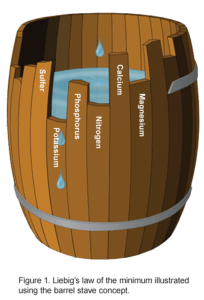
A phenomenon known as Liebig’s law of the minimum, is often used in reference to plant nutrients. Leibig’s law states that the most limiting factor is the one that will limit overall production. Liebig illustrated it using a sketch of a barrel with the lowest stave determining the amount of water that can be held in the barrel. This concept isn’t limited just to nutrient levels and can also be applied to other factors involved in soil fertility. For example, if water is so limited that the plants can’t survive, or if pH is extremely far out of the optimal range for nutrient availability, then improving other fertility factors won’t help. Water or pH is the lowest ‘barrel stave’ or the limiting factor in this example.
As stated, one of the most important fertility factors is biological activity in the soil. However biological life exists within the framework of the soil ecosystem. The soil and management characteristics that support beneficial biological life must be in place to maintain it, e.g., adequate oxygen, moisture, or organic matter. If one of those ‘staves’ is lowest, that particular issue likely needs addressed in order for anything else to have a meaningful impact. It’s important to recognize that we’re managing a system in production agriculture and not just a collection of inputs that can each deliver the specific yield advantage that is shown in the marketing materials. Adding one more input doesn’t necessarily change anything….just about everything depends on everything else.
Does this mean growers and farm managers should avoid using biologicals until everything else is perfect? No, and in fact, many are already using one or more of these products whether intentionally or not. For example, many standard seed treatments that are automatically applied to seed purchases include some form of living or non-living biological product. This is also true for some fertility products. The seed company or manufacturer is convinced of the possible benefits, and the cost is included in the price of the product with no decision by the grower necessary. However, the majority of the biological products on the market are sold to farmers as stand-alone inputs so grower decisions will ultimately drive marketplace success.
In summary the point of this blog post is that an informed assessment of each individual situation and the overall production system currently employed is the best way to maximize the return from this new class of inputs. Contact your local Halderman area representative for guidance and help navigating the challenges of soil health and fertility.