
What is Fertility? – Calcium & Magnesium
By Halderman
What is Fertility? – Calcium & Magnesium
(Seventh in a series)
We continue our discussion of the secondary nutrients focusing this article on Calcium (Ca) and Magnesium (Mg), and their relationship with each other. The role of these two nutrients in agricultural production is often overlooked in traditional fertility discussions which usually focus on the primary macronutrients – Nitrogen (N), Phosphorus (P), and Potassium (K). Why? We don’t typically focus on adding Ca or Mg to the soil through regular fertility programs in the way we do with N, P, and K. That is because they are among the most abundant natural minerals in most Midwest agricultural soils and are naturally derived from the parent material of the soil.
Soil tests express the content of both nutrients as a percentage of base saturation which is the percentage of each of the cations (positively charged ions) that are attached to the negatively charged clay particles in the soil. The total number of cations that a particular soil will hold varies significantly between soil types based on factors like clay content, clay type, and organic matter content. This is known as a soil’s Cation Exchange Capacity or CEC which measures the number of negatively charged sites on the soil particles that are available to ‘hold’ the positively charged cations. The CEC can be thought of as a measurement of the potential nutrient-holding capacity of the soil. The base saturation percentage refers to the relative amount of that potential nutrient-holding capability that is occupied by each cation and is not an absolute measure such as pounds per acre.
The cations that make up the vast majority of the base saturation scores in the Midwest are Ca2+, Mg2+, K+, NH4+ (ammonium), Na+ (sodium), and, if the soil is at all acidic (i.e., below 7 pH) cations such as H+ (hydrogen) will also be present. TypicallyCa and Mg are by far the most abundant cations. Ca base saturations are commonly between 60% and 85%. Common Mg base saturations might be between 10% and 30%. These two nutrients typically occupy most of the nutrient-holding capacity of the soil.
There are at least two aspects of assessing Calcium and Magnesium. Let’s talk about the most obvious first – their role as essential plant nutrients.
Calcium is best known for the role it plays in supporting and stabilizing the cell walls and cell membranes in plants. This is a key aspect of plant health and general disease tolerance. The weaker the cell walls and membranes are, the easier it is for diseases to invade and spread through the plant. Like most nutrients, Ca is also involved in other plant processes, but its impact on plant health through the role it plays in strengthening the cell structures is a very important one. Soils with higher levels of calcium tend to produce healthier crops.
The most notable role of Magnesium is its necessity as a key building block in the chlorophyll molecule. This makes Mg essential for the photosynthetic capability of the plant. Photosynthesis is the process that plants use to turn sunlight, carbon dioxide, and water into energy. The energy is converted to organic compounds – sugars, oils, and proteins. The surplus energy not needed to maintain the plant is converted into the grain we produce. Crop yield is driven by this process of energy creation.
The other aspect of assessing the importance of calcium and magnesium in the soil is the impact that they have on soil structure. To put it simply, Calcium has a positive impact on soil structure because it promotes flocculation – the formation of soil aggregates – by pulling the clay particles together to form aggregates, stabilizing them and associated organic matter. Magnesium has the opposite impact on soil structure. Magnesium is dispersive, which means it tends to push the clay particles apart and discourages aggregate formation and stability. This YouTube video demonstrates the impact of calcium on flocculation quite well. In the video sodium is used as the dispersive agent, but high levels of magnesium can have a similar effect.
Aggregate formation and stability are important for creating adequate pore space between soil aggregates so that water can infiltrate into the surface and through the profile. Likewise, when the water drains, oxygen can fill the pore spaces allowing for root respiration and growth below the soil surface. Oxygen is also necessary for many beneficial microbial species to flourish in the soil. Pore space allows for more robust root growth with less physical resistance. 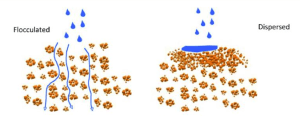
The reason for the opposite impacts of these two cations in the soil is the different types and natures of the chemical bonds each create in the soil profile. A more detailed explanation of that process is beyond both the scope of this blog and the capabilities of this writer. However, the important points to remember are that Calcium is somewhat unique in its tendency to help build good soil structure, while Magnesium is one of several nutrients in the soil that can have a dispersive effect, i.e., a negative effect on soil structure. Sodium (Na) and Potassium (K) are also dispersive in the soil. The impact of sodium can be very deleterious to soil productivity. Even potassium at high base saturations can undermine soil structure. But since Magnesium usually occupies a much higher percentage of the CEC (base saturation) than sodium or potassium, it usually has a greater impact on soil structure and stability and gets more attention.
How do farmers and landowners solve for a Calcium or Magnesium deficiency? Of course, an application of each is possible. In some areas lime is used to lower pH and you can choose either high Cal lime or high Mag lime which will also enhance the Ca of Mg content of the soil, depending on which one is weaker on the soil test. Landowners who have farms close enough to pick which type of lime are very fortunate.
Balancing these two different areas of impact – plant nutrition and soil structure – for both of these essential nutrients is an important part of the management and maximization of soil productivity. This is an area where the expertise of Halderman Farm Managers can deliver very valuable advice specific to your farm. Please contact your local Halderman Area Rep to learn more about these two important nutrients or any other farm related question.